Your first guess in Letroso is the most important one you will make all session. It costs you nothing in terms of information — you have no constraints, no confirmed letters to honor, no eliminated options to avoid. Pure freedom. And most players waste it.
A random opener gives you random information. A well-chosen opener gives you maximum information — specifically, the highest possible chance of confirming useful letters before your second guess. The difference between a three-guess solve and an eight-guess struggle often traces back to the quality of that first word.
This guide covers the best starting words for Letroso, why they work, how word length affects which opener to use, and how to combine your opener with your second guess for maximum early efficiency.
Table of Contents
- Why Your Opening Word Matters More Than You Think
- What Makes a Good Letroso Starting Word
- Best Openers for Five-Letter Puzzles
- Best Openers for Six-Letter Puzzles
- Best Openers for Three and Four-Letter Puzzles
- Best Openers for Seven and Eight-Letter Puzzles
- Two-Word Opening Strategies
- What to Do After Your Opener
- Common Opening Word Mistakes
- Frequently Asked Questions
- Final Thoughts
Why Your Opening Word Matters More Than You Think
In any given Letroso session, your opener sets the frame for everything that follows. It determines which letters you have tested and which remain unknown. It determines whether your second guess can be a genuine deduction or just another probe. It determines whether you are playing from information or from confusion.
Players who use strong, pre-selected openers consistently solve puzzles in fewer guesses than players who type whatever comes to mind. This is not about intelligence or vocabulary size. It is purely about the information value of the opening word.
The logic is straightforward. English uses certain letters far more frequently than others. E, T, A, O, I, N, S, H, R — these nine letters account for the vast majority of letters in common English words. An opener that tests as many of these as possible in one guess maximizes the information returned from that single attempt.
What Makes a Good Letroso Starting Word
A good Letroso opener meets three criteria. First, it contains as many high-frequency letters as possible. Second, it does not repeat any letters — a repeated letter in your opener wastes one of your letter slots on information you could have covered elsewhere. Third, it uses vowels that cover the most common vowel distribution in English words.
The best openers hit three or more vowels while simultaneously covering common consonants. ARISE, for example, gives you A, R, I, S, E — three vowels and two of the most common consonants, with no repeats. That single word tests five letters that collectively appear in a massive percentage of English vocabulary.
Word length matters too. Letroso varies the word length between three and eight letters, and the ideal opener shifts depending on how many boxes you are filling. A five-letter opener is not the right tool for a three-letter puzzle.
Best Openers for Five-Letter Puzzles
Five-letter daily puzzles are the most common length in Letroso. These openers consistently produce the most useful first-guess information:
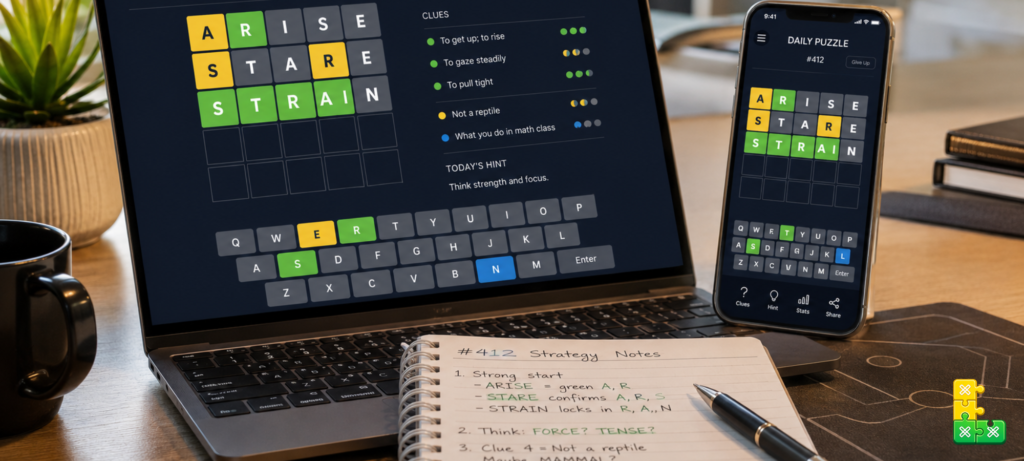
ARISE — covers A, R, I, S, E. Three vowels, two top-tier consonants, zero repeated letters. This is the single most recommended opener for five-letter puzzles. If you are going to commit to one word and use it every day, ARISE is the one.
STARE — covers S, T, A, R, E. Two vowels, three consonants that all rank in the top ten for English frequency. Strong alternative if you want more consonant coverage in exchange for one fewer vowel.
OATEN — covers O, A, T, E, N. Less common word, but the vowel coverage is excellent — O and A together with E tests three of the five most common vowels in a single guess.
CRANE — covers C, R, A, N, E. Two vowels, three consonants. Solid choice if ARISE has not been working for you and you want to test C earlier.
SLATE — covers S, L, A, T, E. Two vowels, three consonants. Frequently recommended in word game communities and works well as a second opener after ARISE eliminates S and E.
Best Openers for Six-Letter Puzzles
Six-letter puzzles give you one more slot to work with, which means your opener can cover more ground. The challenge is finding six-letter words that still avoid repeated letters while hitting high-frequency characters.
STRAIN — covers S, T, R, A, I, N. Two vowels, four common consonants. Excellent coverage for a six-letter opener. Tests no repeated letters and hits several of the most useful consonants in one shot.
PLANET — covers P, L, A, N, E, T. Two vowels, four consonants. Good for testing P and L, which do not appear in STRAIN, making these two words a strong complementary pair.
SENIOR — covers S, E, N, I, O, R. Three vowels, three consonants. Higher vowel coverage than STRAIN, useful when you want to confirm vowel placement earlier.
RETAIL — covers R, E, T, A, I, L. Three vowels, three consonants, no repeats. Balanced option that hits common letters across both categories efficiently.
Best Openers for Three and Four-Letter Puzzles
Shorter puzzles require a completely different opening approach. A five-letter opener is useless when you only have three or four boxes to fill — you need words that specifically test letters likely to appear in short English words.
For three-letter puzzles, the word pool is small but predictable. Common three-letter words favor certain patterns heavily: words ending in T (CAT, BAT, MAT, HAT), words ending in N (RAN, CAN, MAN, PAN), and words with common vowel structures. Good three-letter openers include:
ATE — covers A, T, E. Three of the most common letters in short English words. RAN — covers R, A, N. Tests a common short-word consonant cluster. OAT — covers O, A, T. High vowel density for a three-letter word.
For four-letter puzzles, slightly more latitude exists but the pool is still constrained. RAIN, LEAN, SEAT, and PARE all cover useful letter combinations while keeping all four letters distinct.
Best Openers for Seven and Eight-Letter Puzzles
Longer puzzles are where most players struggle most. The temptation is to use familiar words, but familiar words often use repeated letters or focus on less common letter combinations.
For seven-letter openers, you want words that cover as many of the top-frequency letters as possible across all seven slots:
PAINTER — covers P, A, I, N, T, E, R. Seven distinct letters, three vowels, four consonants, and hits several of the most common characters in English.
LANTERN — covers L, A, N, T, E, R, N. Note this repeats N, which makes it slightly less efficient. Better to use PAINTER or CENTRAL instead.
CENTRAL — covers C, E, N, T, R, A, L. Seven distinct letters, excellent consonant and vowel balance.
For eight-letter puzzles, finding strong openers with eight distinct high-frequency letters is genuinely difficult. PERSONAL covers P, E, R, S, O, N, A, L — eight distinct letters and reasonable frequency coverage. RELATION covers R, E, L, A, T, I, O, N — three vowels and five common consonants with no repeats, making it one of the stronger eight-letter openers available.
Two-Word Opening Strategies
Some players prefer to think of their first two guesses together as a combined opening strategy rather than just the first word alone. This approach can be especially effective in standard mode where you have unlimited guesses.
The ARISE + CLOTH combination tests A, R, I, S, E from the first word and C, L, O, T, H from the second — ten distinct letters covering most of the high-frequency consonants and all five common vowels in just two guesses.
The STARE + CLOUDY combination similarly covers S, T, A, R, E in the first word and C, L, O, U, D, Y in the second — again hitting ten letters with strong frequency coverage.
The value of this approach is that after two guesses you have tested a large portion of the alphabet’s most common letters. Your third guess can be a genuine deduction rather than another probe.
This strategy is discussed in more detail in the best strategies to solve Letroso faster guide, which covers the full mid-game and endgame approach alongside the opening.
What to Do After Your Opener
Your opener is not useful by itself — it is useful because of what you do with the information it returns. After your first guess is revealed, spend ten seconds reading the board before typing anything.
Check every color. A green tile means a locked position — stop thinking about it. A yellow tile means a confirmed letter in the wrong position — note which position it cannot be in. A grey tile means the letter is eliminated.
Check the connection lines between tiles. If two tiles are connected, those letters are adjacent in the final word. This is additional information that your opener generated for free, and it is worth processing before your second guess.
Only after reading all of this should you start thinking about your second word. The second guess should use the confirmed letters from your opener in new positions, avoid the eliminated letters, and ideally cover additional high-frequency letters that your opener did not test.
The How to Play Letroso beginner guide covers how to read each clue type clearly, which is worth reviewing if any of the board elements are still unfamiliar.
Common Opening Word Mistakes
Using repeated letters in your opener is the most common mistake. A word like COCOA wastes two C slots and two O slots on a single pair of letters each. You have given up four letter slots for two letters’ worth of information.
Using rare letters in your opener is the second mistake. Testing Q, Z, X, or J in your first guess is almost always a waste — these letters appear in such a small percentage of English words that confirming their absence gives you very little information. Save uncommon letters for later guesses when you have more context.
Changing your opener every day is the third mistake. Consistency matters. When you use the same opener every session, you develop an automatic baseline — you know exactly what information you will always have after guess one, which makes processing the results faster and more intuitive. Pick your opener and stick with it.
Using a word you are not sure how to spell is the fourth mistake. If you are uncertain about the spelling, the game will reject your guess and you lose a moment of composure. Keep your opener as a word you can type without hesitation.
Frequently Asked Questions
What is the single best starting word for Letroso? For five-letter puzzles, ARISE is the most consistently recommended opener. It covers three vowels and two high-frequency consonants with no repeated letters, giving you maximum information from a single guess.
Should I use the same opener every day? Yes. Consistency in your opener builds pattern recognition faster than changing it daily. Decide on one word and use it every session.
Does word length affect which opener I should use? Significantly. A five-letter opener is not useful for a three-letter puzzle. Always match your opener to the word length shown on the board. Check the number of boxes before typing anything.
Can a two-word opening strategy work in hard mode? Not in the same way. Hard mode requires that every guess uses your confirmed information, so your second guess cannot be a pure elimination word if your first guess confirmed any letters. The two-word opener strategy works best in standard unlimited mode.
Is SLATE a good Letroso opener? Yes, SLATE is a solid opener that covers S, L, A, T, E. It is particularly effective as a second opener after ARISE, since it tests L and T while avoiding S and E which your first guess already covered.
What if my opener turns up mostly grey tiles? A mostly grey first guess is actually useful information. It tells you which letters to avoid in all subsequent guesses. Proceed to your second word, focus on covering different high-frequency letters, and use the small number of confirmed results from your opener to constrain the remaining possibilities.
Final Thoughts
The opening word is the one part of every Letroso puzzle that you can fully control before the session starts. Every other decision depends on what the board tells you. Your opener depends only on what you have decided in advance.
Pick ARISE for five-letter puzzles. Pick STRAIN or PLANET for six-letter ones. Match the length to the puzzle, stick with your chosen opener consistently, and spend the ten seconds after your first guess reading the full board before typing your second word.
That combination — a strong opener, consistent use of it, and careful board reading after — accounts for more improvement in guess efficiency than any other single change a player can make.
Head to Letroso and apply this to today’s daily puzzle. Check today’s word length first, choose the right opener for it, and see how much earlier the answer comes together compared to your usual approach.